Top 100 Science Quotes of All Time

A short, finished list rather than an endless feed: 100 of the best science quotes ever written, picked out of the full science archive on QuoteForever. You will find Bertrand Russell, Albert Einstein, Carl Sagan and Charles Darwin among them.

Read the list top to bottom, or use it as a starting point - every author name links to everything else they said, and every quote has its own page you can share or turn into an image.
1

The real problem is not whether machines think but whether men do.

2

I think this is the most extraordinary collection of talent, of human knowledge, that has ever been gathered at the White House - with the possible exception of when Thomas Jefferson dined alone.

3

All models are wrong, but some are useful.

4

Imagination is as vital to any advance in science as learning and precision are essential for starting points.

5

Mathematical Mark all mathematical heads, which be only and wholly bent to those sciences, how solitary they be themselves, how unfit to live with others, and how unapt to serve in the world.

6

Nature is accustomed to hide itself.

7

Time is in itself [not] a difficulty, but a time-rate, assumed on very insufficient grounds, is used as a master-key, whether or not it fits, to unravel all difficulties. What if it were suggested that the brick-built Pyramid of Hawara had been laid brick by brick by a single workman? Given time, this would not be beyond the bounds of possibility. But Nature, like the Pharaohs, had greater forces at her command to do the work better and more expeditiously than is admitted by Uniformitarians.

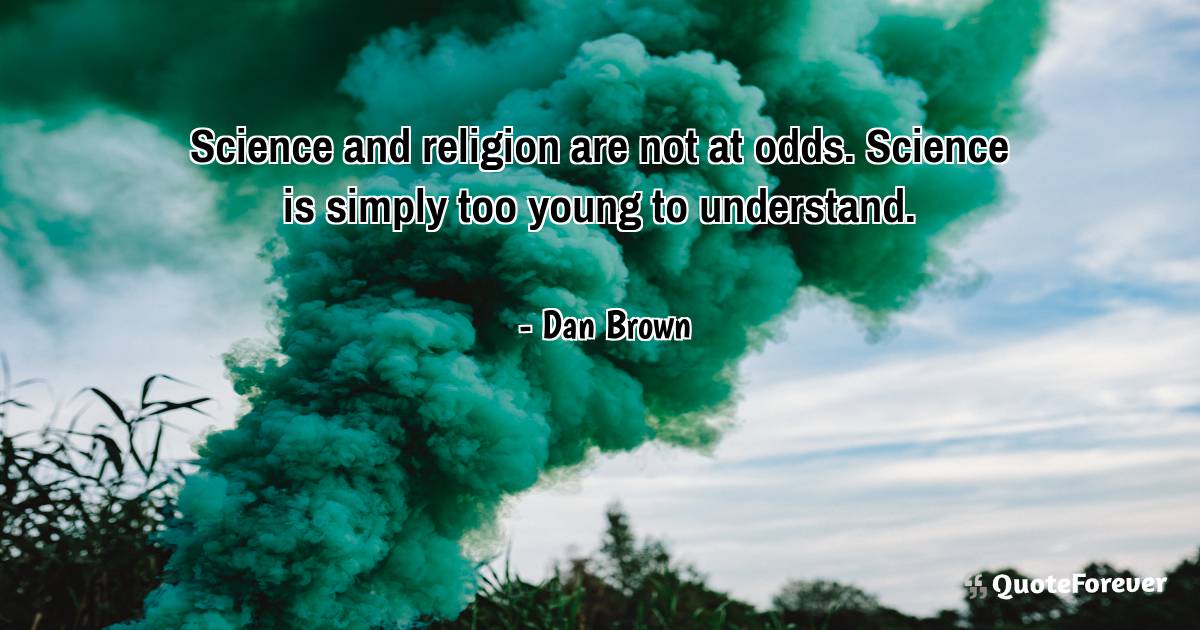
Science and religion are not at odds. Science is simply too young to ... - Dan Brown 8

Science and religion are not at odds. Science is simply too young to understand.

9

But poverty, though it does not prevent the generation, is extremely unfavourable to the rearing of children. The tender plant is produced, but in so cold a soil, and so severe a climate, soon withers and dies.

10

We are not clear as to the role in life of these chemicals; nor are we clear as to the role of the physician. You know, of course, that in ancient times there was no clear distinction between priest and physician.

11

To raise new questions, new possibilities, to regard old problems from a new angle, requires creative imagination and marks real advance in science.

12

It is harder to crack prejudice than an atom.

13

Curiosity has its own reason for existence.

14

We can invent as many theories we like, and any one of them can be made to fit the facts. But that theory is always preferred which makes the fewest number of assumptions.

15

To be sure, it is not the fruits of scientific research that elevate a man and enrich his nature, but the urge to understand, the intellectual work, creative or receptive.

16

Man has an intense desire for assured knowledge.

17

I don't believe in mathematics.

18

To regulate something always requires two opposing factors. You cannot regulate by a single factor. To give an example, the traffic in the streets could not be controlled by a green light or a red light alone. It needs a green light and a red light as well. The ratio between retine and promine determines whether there is any motion, any growth, or not. Two different inclinations have to be there in readiness to make the cells proliferate.

19

Each metal has a certain power, which is different from metal to metal, of setting the electric fluid in motion.

20

In the company of friends, writers can discuss their books, economists the state of the economy, lawyers their latest cases, and businessmen their latest acquisitions, but mathematicians cannot discuss their mathematics at all. And the more profound their work, the less understandable it is.

21

The laws of physics and chemistry must be the same in a crucible as in the larger laboratory of Nature.

22

This world was once a fluid haze of light, Till toward the centre set the starry tides, And eddied into suns, that wheeling cast The planets: then the monster, then the man.

23

In the old days, they killed the messenger who brought the bad news... a Cassandra is never popular in her time.

24

POTABLE, n. Suitable for drinking. Water is said to be potable; indeed, some declare it our natural beverage, although even they find it palatable only when suffering from the recurrent disorder known as thirst, for which it is a medicine. Upon nothing has so great and diligent ingenuity been brought to bear in all ages and in all countries, except the most uncivilized, as upon the invention of substitutes for water. To hold that this general aversion to that liquid has no basis in the preservative instinct of the race is to be unscientific-and without science we are as the snakes and toads.

25

Whatever the scientists may say, if we take the supernatural out of life, we leave only the unnatural.

26

Men are not created to know, men are not created to understand ... and our illusions increase with our knowledge.

27

In space everything is different, you sleep on the ceiling.

28

There is a new science of complexity which says that the link between cause and effect is increasingly difficult to trace; that change (planned or otherwise) unfolds in non-linear ways; that paradoxes and contradictions abound; and that creative solutions arise out of diversity, uncertainty and chaos.

29

Psychologists pay lip service to the scientific method, and use it whenever it is convenient; but when it isn't they make wild leaps of their uncontrolled fancy.

30

A biologist, if he wishes to know how many toes a cat has, does not "frame the hypothesis that the number of feline digital extremities is 4, or 5, or 6," he simply looks at a cat and counts. A social scientist prefers the more long-winded expression every time, because it gives an entirely spurious impression of scientificness to what he is doing.

31

The dreadful cocksureness that is characteristic of scientists in bulk is not only quite foreign to the spirit of true science, it is not even justified by a superficial view.

32

Mr. Hillaire Belloc has pointed out that science has changed greatly, and for the worse, since it became popular. Some hundred years ago, or more, only very unusual, highly original spirits were attracted to science at all; scientific work was therefore carried out by men of exceptional intelligence. Now, scientists are turned out by mass production in our universities.

33

The laws of biology are the fundamental lessons of history.

34

Therefore, the good of man must be the end of the science of politics.

35

Conscientious and careful physicians allocate causes of disease to natural laws, while the ablest scientists go back to medicine for their first principles.

36

Politicians should read science fiction, not westerns and detective stories.

37

Typical of the fundamental scientific problems whose solution should lead to important industrial consequences are, for example, the release of atomic energy, which experiment has shown to exist in quantities millions of times greater than is liberated by combustion.

38

That our knowledge only illuminates a small corner of the Universe, that it is incomplete, approximate, tentative and merely probable need not concert us. It is genuine nevertheless. Physical science stands as one of the great achievements of the human spirit.

39

Our ultimate analysis of space leads us not to a "here" and a "there," but to an extension such as that which relates "here" and "there." To put the conclusion rather crudely-space is not a lot of points close together; it is a lot of distances interlocked.

40

An electron is no more (and no less) hypothetical than a star. Nowadays we count electrons one by one in a Geiger counter, as we count the stars one by one on a photographic plate.

41

When an investigator has developed a formula which gives a complete representation of the phenomena within a certain range, he may be prone to satisfaction. Would it not be wiser if he should say 'Foiled again! I can find out no more about Nature along this line.'

42

To her friends said the Bright one in chatter, "I have learned something new about matter: My speed was so great, Much increased was my weight, Yet I failed to become any fatter!"

43

Next to the word 'Nature,' 'the Great Chain of Being' was the sacred phrase of the eighteenth century, playing a part somewhat analogous to that of the blessed word 'evolution' in the late nineteenth.

44

The theory of the lung as a gland has justified its existence and done excellent service in bringing forward facts, which shall survive any theoretical construction that has been or may hereafter be put upon them.

45

As for methods I have sought to give them all the rigour that one requires in geometry, so as never to have recourse to the reasons drawn from the generality of algebra.

46

If that's how it all started, then we might as well face the fact that what's left out there is a great deal of shrapnel and a whole bunch of cinders (one of which is, fortunately, still hot enough and close enough to be good for tanning). Trying to find some sense and order in this mess may be as futile as trying to ... reconstruct the economy of Iowa from a bowl of popcorn. [On searching for evidence of the Big Bang.]

47

Measure, time and number are nothing but modes of thought or rather of imagination.

48

A new truth is a truth, an old error is an error.

49

Science would be ruined if (like sports) it were to put competition above everything else, and if it were to clarify the rules of competition by withdrawing entirely into narrowly defined specialties. The rare scholars who are nomads-by-choice are essential to the intellectual welfare of the settled disciplines.

50

A fractal is a mathematical set or concrete object that is irregular or fragmented at all scales...

51

The security provided by a long-held belief system, even when poorly founded, is a strong impediment to progress. General acceptance of a practice becomes the proof of its validity, though it lacks all other merit.

52

[I have seen] workers in whom certain morbid affections gradually arise from some particular posture of the limbs or unnatural movements of the body called for while they work. Such are the workers who all day stand or sit, stoop or are bent double, who run or ride or exercise their bodies in all sorts of [excess] ways. ... the harvest of diseases reaped by certain workers ... [from] irregular motions in unnatural postures of the body.

53

Not only in antiquity but in our own times also laws have been passed...to secure good conditions for workers; so it is right that the art of medicine should contribute its portion for the benefit and relief of those for whom the law has shown such foresight...[We] ought to show peculiar zeal...in taking precautions for their safety. I for one have done all that lay in my power, and have not thought it beneath me to step into workshops of the meaner sort now and again and study the obscure operations of mechanical arts.

54

Science may set limits to knowledge, but should not set limits to imagination.

55

In attempting to understand the elements out of which mental phenomena are compounded, it is of the greatest importance to remember that from the protozoa to man there is nowhere a very wide gap either in structure or in behaviour. From this fact it is a highly probable inference that there is also nowhere a very wide mental gap.

56

Even if the open windows of science at first make us shiver after the cozy indoor warmth of traditional humanizing myths, in the end the fresh air brings vigor, and the great spaces have a splendor of their own.

57

[Man] ... his origin, his growth, his hopes and fears, his loves and his beliefs are but the outcome of accidental collocations of atoms; that no fire, no heroism, no intensity of thought and feeling can preserve an individual life beyond the grave; that all the labour of the ages, all the devotion, all the inspiration, all the noonday brightness of human genius are destined to extinction in the vast death of the solar system, and that the whole temple of Man's achievement must inevitably be buried beneath the debris of a universe in ruins.

58

Physics is mathematical not because we know so much about the physical world, but because we know so little; it is only its mathematical properties that we can discover.

59

Science is what we know, and philosophy is what we don't know.

60

Although this may seem a paradox, all exact science is dominated by the idea of approximation. When a man tells you that he knows the exact truth about anything, you are safe in inferring that he is an inexact man. Every careful measurement in science is always given with the probable error ... every observer admits that he is likely wrong, and knows about how much wrong he is likely to be.

61

All that passes for knowledge can be arranged in a hierarchy of degrees of certainty, with arithmetic and the facts of perception at the top.

62

[The Royal Society] is quite simply the voice of science in Britain. It is intellectually rigorous, not afraid to be outspoken on controversial issues such as climate change, but it is not aggressively secular either, insisting on a single view of the world. In fact, there are plenty of eminent scientists - Robert Winston, for instance - who are also men of faith.

63

It isn't easy to become a fossil. ... Only about one bone in a billion, it is thought, becomes fossilized. If that is so, it means that the complete fossil legacy of all the Americans alive today - that's 270 million people with 206 bones each - will only be about 50 bones, one-quarter of a complete skeleton. That's not to say, of course, that any of these bones will ever actually be found.

64

You don't need a science degree to understand about science. You just need to think about it.

65

Never before in history has innovation offered promise of so much to so many in so short a time.

66

When we see the shadow on our images, are we seeing the time 11 minutes ago on Mars? Or are we seeing the time on Mars as observed from Earth now? It's like time travel problems in science fiction. When is now; when was then?

67

They think they can make fuel from horse manure - now, I don't know if your car will be able to get 30 miles to the gallon, but it's sure gonna put a stop to siphoning.

68

Most of the programmers in ten years will be us, and we won't get much smarter.

69

I do not think that G. H. Hardy was talking nonsense when he insisted that the mathematician was discovering rather than creating, nor was it wholly nonsense for Kepler to exult that he was thinking God's thoughts after him. The world for me is a necessary system, and in the degree to which the thinker can surrender his thought to that system and follow it, he is in a sense participating in that which is timeless or eternal.

70

[W.H.R.] Rivers is the Rider Haggard of anthropology; I shall be the Conrad.

71

The effort to eliminate synthetic pesticides because of unsubstantiated fears about residues in food will make fruits and vegetables more expensive, decrease consumption, and thus increase cancer rates. The levels of synthetic pesticide residues are trivial in comparison to natural chemicals, and thus their potential for cancer causation is extremely low. [Ames believes that "to eat your veggies" is the best way to prevent cancer.]

72

It is...idle to pretend, as many do, that there is no contradiction between religion and science. Science contradicts religion as surely as Judaism contradicts Islam-they are absolutely and irresolvably conflicting views. Unless, that is, science is obliged to change its fundamental nature.

73

A good many times I have been present at gatherings of people who, by the standards of the traditional culture, are thought highly educated and who have with considerable gusto been expressing their incredulity at the illiteracy of scientists. Once or twice I have been provoked and have asked the company how many of them could describe the Second Law of Thermodynamics. The response was cold: it was also negative. Yet I was asking something which is about the scientific equivalent of: Have you read a work of Shakespeare's?

74

No scientist or student of science, need ever read an original work of the past. As a general rule, he does not think of doing so. Rutherford was one of the greatest experimental physicists, but no nuclear scientist today would study his researches of fifty years ago. Their substance has all been infused into the common agreement, the textbooks, the contemporary papers, the living present.

75

It is the greatest truth of our age: Information is not knowledge.

76

My young friend, I wish that science would intoxicate you as much as our good Göttingen beer! Upon seeing a student staggering down a street.

77

Classical physics has been superseded by quantum theory: quantum theory is verified by experiments. Experiments must be described in terms of classical physics.

78

The unconscious psyche believes in life after death

79

For the first time there was constructed with this machine [locomotive engine] a self-acting mechanism in which the interplay of forces took shape transparently enough to discern the connection between the heat generated and the motion produced. The great puzzle of the vital force was also immediately solved for the physiologist in that it became evident that it is more than a mere poetic comparison when one conceives of the coal as the food of the locomotive and the combustion as the basis for its life.

80

[An engineer's] invention causes things to come into existence from ideas, makes world conform to thought; whereas science, by deriving ideas from observation, makes thought conform to existence.

81

If you ask the fish whether they'd rather have an oil spill or a season of fishing, I wouldn't be surprised if they'd vote for another blowout.

82

The notion that science and spirituality are somehow mutually exclusive does a disservice to both.

83

Demon mean knowledge in Greek, especially about the material world. Science means knowledge in Latin. A jurisdictional dispute is exposed, even if we look no further

84

The claim is also sometimes made that science is as arbitrary or irrational as all other claims to knowledge, or that reason itself is an illusion. As Ethan Allen said Those who invalidate reason ought seriously to consider whether they argue against reason with or without reason; if with reason, then they establish the principle that they are labouring to dethrone. If they argue without reason, which they must do, in order to be consistent with themselves, they are out of reach of rational conviction, nor do they deserve a rational argument.

85

I maintain there is much more wonder in science than in pseudoscience. And in addition, to whatever measure this term has any meaning, science has the additional virtue, and it is not an inconsiderable one, of being true.

86

The size and age of the Cosmos are beyond ordinary human understanding. Lost somewhere between immensity and eternity is our tiny planetary home.

87

We are made of starstuff.

88

[N]o scientist likes to be criticized. ... But you don't reply to critics: "Wait a minute, wait a minute; this is a really good idea. I'm very fond of it. It's done you no harm. Please don't attack it." That's not the way it goes. The hard but just rule is that if the ideas don't work, you must throw them away. Don't waste any neurons on what doesn't work. Devote those neurons to new ideas that better explain the data. Valid criticism is doing you a favor.

89

Science is the refusal to believe on the basis of hope.

90

For one person who is blessed with the power of invention, many will always be found who have the capacity of applying principles.

91

Remember that accumulated knowledge, like accumulated capital, increases at compound interest: but it differs from the accumulation of capital in this; that the increase of knowledge produces a more rapid rate of progress, whilst the accumulation of capital leads to a lower rate of interest. Capital thus checks it own accumulation: knowledge thus accelerates its own advance. Each generation, therefore, to deserve comparison with its predecessor, is bound to add much more largely to the common stock than that which it immediately succeeds.

92

Science in England is not a profession: its cultivators are scarcely recognised even as a class. Our language itself contains no single term by which their occupation can be expressed. We borrow a foreign word [Savant] from another country whose high ambition it is to advance science, and whose deeper policy, in accord with more generous feelings, gives to the intellectual labourer reward and honour, in return for services which crown the nation with imperishable renown, and ultimately enrich the human race.

93

A mathematician is a blind man in a dark room looking for a black cat which isn't there.

94

Nothing before had ever made me thoroughly realise, though I had read various scientific books, that science consists in grouping facts so that general laws or conclusions may be drawn from them.

95

Nothing can be more improving to a young naturalist, than a journey in a distant country.

96

It is often said that all the conditions for the first production of a living organism are now present, which could ever have been present. But if (and oh! what a big if!) we could conceive in some warm little pond, with all sorts of ammonia and phosphoric salts, light, heat, electricity, &c., present, that a proteine compound was chemically formed ready to undergo stillmore complex changes, at the present day such matter would be instantly devoured or absorbed, which would not have been the case before living creatures were formed.

97

I find in the domestic duck that the bones of the wing weigh less and the bones of the leg more, in proportion to the whole skeleton, than do the same bones in the wild duck; and this change may be safely attributed to the domestic duck flying much less, and walking more, than its wild parents.

98

Any one whose disposition leads him to attach more weight to unexplained difficulties than to the explanation of facts will certainly reject my theory.

99

The history of science is a record of the transformations of contempts amd amusements.

100

I would walk - not run - to the nearest seismograph.

Share This Page